




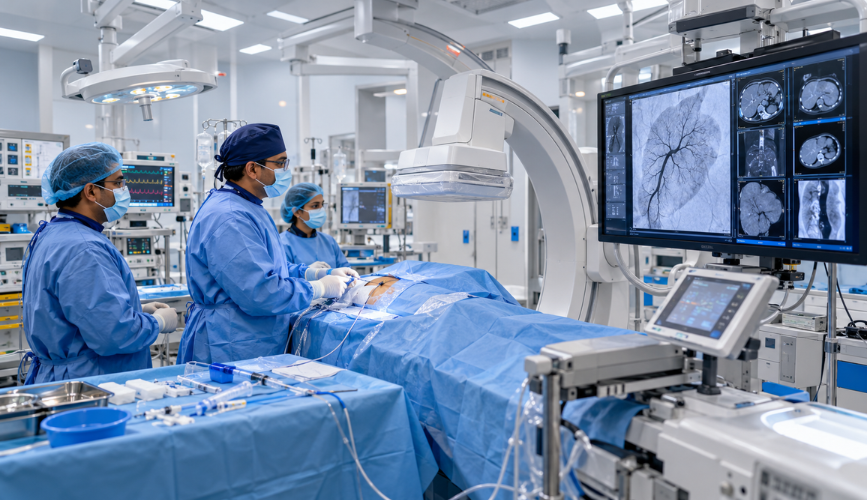
Interventional Radiology
Interventional radiologists use imaging to guide thin catheters, needles and devices through the skin or blood vessels to diagnose and treat disease. In liver care, IR can control bleeding, open blocked bile ducts, treat tumours, reduce portal pressure and manage complications after transplant. Because incisions are minimal, patients often recover faster and can be treated even when surgery is risky.
Procedures for Liver Tumours
- TACE (transarterial chemoembolisation): Chemotherapy and embolic material are delivered directly into the artery feeding the tumour, cutting off blood supply and concentrating treatment.
- TARE (radioembolisation): Tiny radioactive beads are delivered to the tumour, used in selected patients depending on availability.
- Radiofrequency and microwave ablation: Heat destroys small tumours under image guidance, often as a curative option for early cancer or a bridge to transplant.
- Portal vein embolisation: Blocks a branch of the portal vein to grow the healthy remnant liver before a major resection.
- Biopsy: Image-guided sampling for diagnosis.
Procedures for Portal Hypertension
- TIPS (transjugular intrahepatic portosystemic shunt): Creates a channel between the portal and hepatic veins to lower pressure. It is used for variceal bleeding that is not controlled by endoscopy, recurrent bleeding and refractory ascites in selected patients.
- BRTO and related procedures: Treat gastric varices when endoscopic options are limited.
- Splenic artery embolisation: In selected patients with severe hypersplenism.
- Transjugular liver biopsy and pressure measurements: Useful when clotting problems or ascites make percutaneous biopsy unsafe.
Biliary Interventions
- Percutaneous transhepatic biliary drainage (PTBD): Relieves obstruction and infection by draining bile through the liver
- Biliary stenting and dilation: Opens strictures from tumours, injury or post-transplant narrowing
- Stone removal in selected cases
- Cholecystostomy: Drainage of the gallbladder in critically ill patients
Drainage Procedures
- Liver abscess drainage: Ultrasound or CT-guided catheter placement
- Hydatid and other cyst treatment: Drainage and sclerotherapy in selected cases
- Paracentesis and pleural drainage: For ascites and fluid around the lungs
- Percutaneous drainage of abdominal collections
Vascular Interventions After Transplant
- Hepatic artery thrombosis or stenosis: Thrombolysis, angioplasty or stenting to save the graft
- Portal vein and hepatic vein narrowing: Balloon dilation and stenting
- Bile duct strictures and leaks: Percutaneous drainage and dilation
- Fluid collections: Image-guided drainage
Emergency Interventions
IR is often life-saving in emergencies:
- Embolisation for bleeding: From liver trauma, ruptured tumours or after surgery
- Variceal bleeding rescue: TIPS when other measures fail
- Cholangitis: Urgent biliary drainage
- Vascular access: Placement of dialysis or central lines
Preparing for a Procedure
- Fasting as instructed, usually 6 hours
- Blood tests for clotting, platelets, kidney function and infection
- Adjusting blood thinners, diabetes medicines and antiplatelet drugs under medical advice
- Informing the team about allergies, especially to contrast
- Arranging an adult to stay with you after the procedure
- Signing informed consent after discussing risks and alternatives
What Happens During the Procedure
Most IR procedures are performed under local anaesthesia with sedation, though some need general anaesthesia. Using ultrasound, fluoroscopy or CT, the radiologist places the needle or catheter accurately, delivers treatment and confirms the result on imaging. Procedures may last from 30 minutes to a few hours, depending on complexity.
Recovery
After a procedure, patients are observed for several hours or overnight. Puncture sites are checked for bleeding, and vital signs are monitored. Mild pain, low-grade fever or fatigue can follow TACE, usually settling within days. Your team will explain when you can eat, walk and resume normal activities, and how often follow-up imaging will be needed.
Risks and Benefits
Benefits include shorter hospital stay, less pain, lower risk than major surgery and the ability to treat patients who are not fit for operation. Risks depend on the procedure and may include bleeding, infection, bile leak, vessel injury, contrast reaction, kidney injury, hepatic encephalopathy after TIPS or liver dysfunction after embolisation. Your team discusses the specific risks before any procedure.
Team Approach
IR does not work in isolation. Treatment plans are decided with hepatologists, surgeons, oncologists and transplant physicians, often at a joint tumour board. A patient with liver cancer, for example, may receive ablation, TACE, resection, transplant or systemic therapy, or a sequence of these, depending on the stage and liver function.
Equipment and Safety
The IR suite is equipped with digital subtraction angiography, ultrasound, CT guidance and radiation-protection measures. Staff use dose-reduction techniques, lead protection and monitoring. Sterile procedures, trained nurses and anaesthesia support ensure safe care, and immediate access to the ICU and surgery is available if required.
Consult Our IR Team
If your doctor has suggested TIPS, TACE, ablation, drainage or embolisation, or you want a second opinion on minimally invasive options, contact LiverMitra to speak with our interventional radiology team.

