




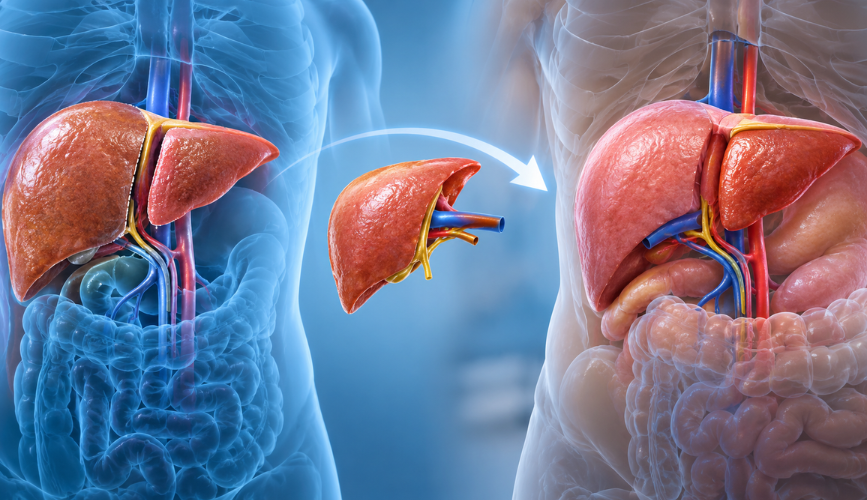
Living-Donor Liver Transplant
In a living-donor liver transplant, a healthy person donates part of their liver to a patient with end-stage liver disease. The liver is unique among solid organs because it regenerates. After surgery, the donor's remaining liver and the transplanted portion in the recipient both grow, typically reaching near-normal volume within a few weeks to months. This makes LDLT possible and has made it an important option, especially where deceased donors are limited.
Why Consider Living-Donor Transplant?
- Shorter or no waiting time: Surgery can be scheduled once a suitable donor is cleared, which matters for patients whose condition is worsening.
- Planned timing: The operation can be done at the best moment medically, before serious complications develop.
- Excellent graft quality: The donor is thoroughly assessed in advance and the liver is transplanted within a short time.
- Reduces pressure on the deceased-donor list: Every LDLT frees a liver for another patient.
Who Can Be a Donor?
A living donor is usually a close family member or a person with an emotional bond to the patient, and donation must be voluntary. In India, donation is regulated under the Transplantation of Human Organs and Tissues Act, and approval from the authorisation committee is required. General requirements include:
- Age typically between 18 and 55 years
- Compatible blood group with the recipient
- Good overall health, with no significant liver, heart, lung, or kidney disease
- Suitable liver size and anatomy, confirmed by imaging
- Willingness to donate without pressure or payment
- Acceptable body weight and no active infection
Final eligibility is decided by the transplant team after complete testing.
Donor Evaluation
Donor safety is our priority. Evaluation includes blood tests, imaging such as CT or MRI to assess liver volume and blood vessel and bile duct anatomy, cardiac and lung screening, infection screening, and psychological and social assessment. The donor is counselled independently, so they can make an informed and free decision. A donor can withdraw at any time without explanation.
The Surgery
LDLT involves two coordinated operations. In the donor operation, the surgeon removes the right lobe, left lobe or left lateral segment, depending on the recipient's size and needs, while preserving the donor's blood supply and bile drainage. In the recipient operation, the diseased liver is removed and the donor graft is connected to the recipient's blood vessels and bile duct. Both surgeries are complex and are performed by experienced teams working in parallel.
Recovery for the Donor
Donors are monitored in the ICU or high-dependency unit initially and usually stay in hospital for about a week. Most return to light activity within a few weeks and to regular work and routine within about two to three months, although timelines vary. Regular follow-up checks liver regeneration and overall health. Donors do not need lifelong immunosuppression.
Recovery for the Recipient
Recipients spend time in the ICU, followed by a transplant ward. Immunosuppressive medicines are started to prevent rejection and are usually continued long term. Nutrition, physiotherapy, infection prevention and regular blood tests form the core of recovery. Most recipients gradually regain strength and resume normal life over the following months.
Risks and Considerations
For the recipient, risks include bleeding, infection, bile duct leaks or narrowing, blood vessel complications and rejection. For the donor, as with any major operation, there are risks such as bleeding, infection, bile leak and, rarely, serious complications. Our team discusses these risks openly and in detail with both donor and recipient before any decision is made. Donation is never pursued if it would put the donor's safety at unacceptable risk.
Adult and Pediatric Living-Donor Transplant
LDLT is commonly used for children, where a small left lateral segment from a parent can be an excellent fit. It is also widely used for adults, often using a right lobe graft to provide enough liver volume. Graft selection depends on the recipient's weight, disease severity and the donor's anatomy.
Our Approach
Our program works with two dedicated teams so that both donor and recipient have their own specialists and coordinators. We use detailed imaging planning, careful surgical technique and structured follow-up. Counsellors help families understand the process, and coordinators assist with legal documentation and committee approvals.
Get in Touch
If you are considering donating or need a transplant for a loved one, our team can explain the process, answer your questions and begin evaluation. Contact us to schedule a confidential consultation.

